In short
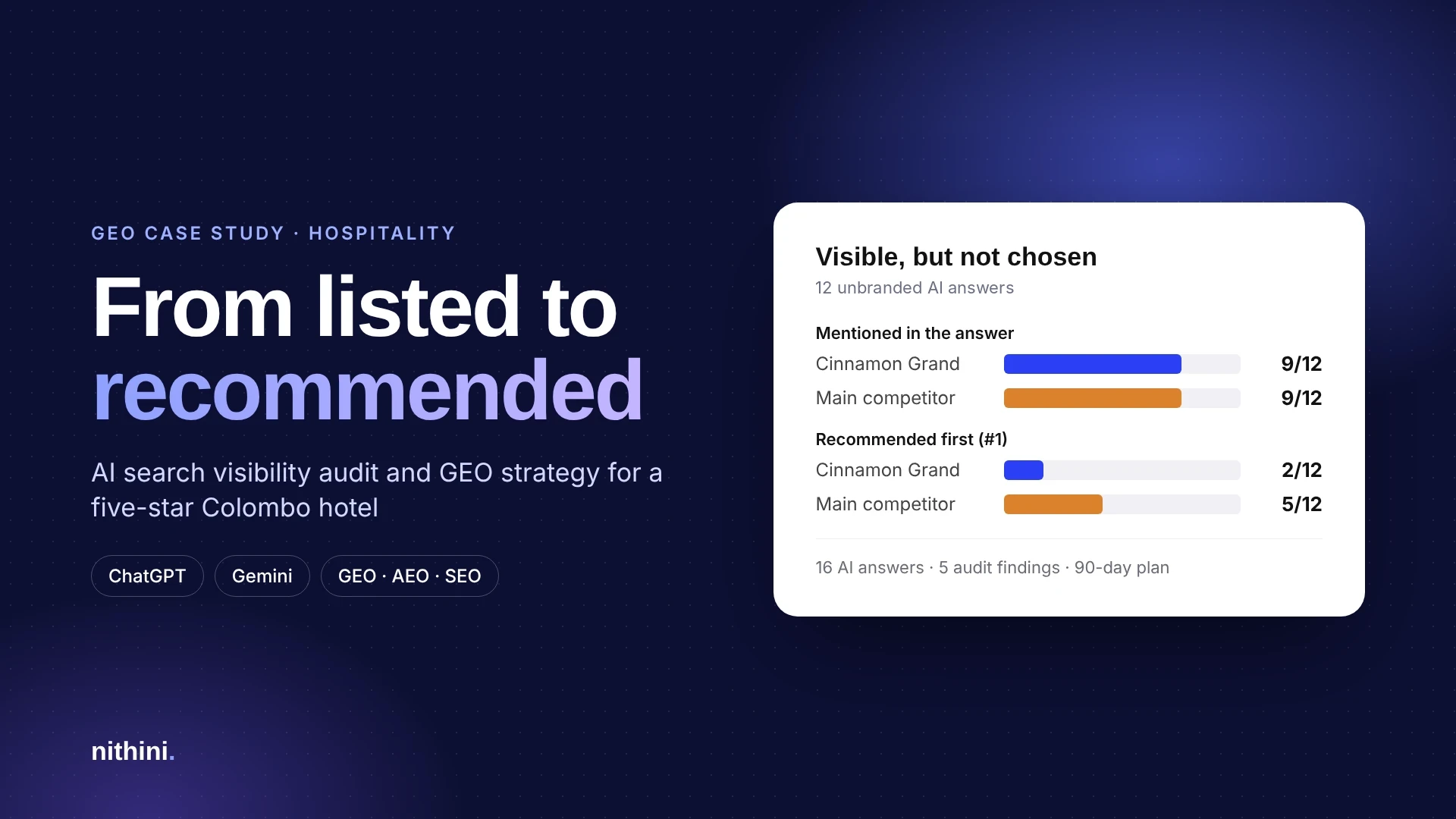
Travellers now ask ChatGPT and Gemini where to stay. I tested how both AI assistants recommend Cinnamon Grand Colombo, audited the hotel's website for GEO and technical SEO, and built a 90-day strategy to move it from being listed to being recommended.
Key insight: the hotel often had the better product. Its competitors described theirs better, and AI recommends what it can read, quote and verify.
The challenge: hotel visibility in AI search
Instead of ten blue links, a traveller using AI gets one answer and a shortlist. So the question for any hotel is simple: when a traveller asks AI where to stay in Colombo, does it get recommended? If not, why not, and what would change that?
The goal was a practical, prioritised GEO strategy focused on the highest-impact opportunities, not an exhaustive audit.
My GEO approach: from evidence to action
- Test
Ran 8 traveller prompts on ChatGPT and Gemini, logging mentions, rankings, competitors, cited sources and factual errors.
16 AI answers - Audit
Reviewed the website through what AI could and couldn't find, plus robots.txt and Google's Rich Results Test.
5 opportunities - Prioritise
Chose the traveller audiences where the visibility gap was biggest and the product could win.
5 audiences - Plan
Designed onsite and offsite content opportunities and sequenced them into a roadmap.
90-day roadmap - Measure
Built a monthly framework for AI share of voice, factual accuracy and AI referral traffic.
4 monthly KPIs
Research: AI search visibility assessment
Why ChatGPT and Gemini
The two assistants get their information in different ways, so testing both covers the two routes a traveller might take to the hotel:
"Where should we stay in Colombo?"
with search
hotel website, OTAs, travel guides · shows sources
Maps, Business Profile, reviews · same ecosystem as AI Overviews
Prompt design that follows the traveller journey
Instead of testing trending keywords, I wrote prompts the way real travellers talk to AI: long, specific and conversational. Each prompt maps to a stage of brand awareness, an approach taken from UX customer journey mapping.
- Unbranded Need-driven Doesn't know the brand
First-time visitor looking for a central luxury hotel
- Unbranded Facility-driven Knows the features they want
Business trip, family stay, conference for 100 people
- Unbranded Experience-driven Wants a specific experience
Local luxury staycation, traditional Sri Lankan food
- Branded Comparing Has a shortlist
Cinnamon Grand vs Shangri-La vs Hilton
- Branded Brand-aware Checking before booking
"Is Cinnamon Grand a good choice for a family stay?"
Prompts 1–6 were unbranded, testing whether AI recommends the hotel on its own. Prompts 7–8 were branded, testing whether AI describes it accurately.
"Where should a family with two children aged 6 and 10 stay in Colombo? We want a pool, suitable room arrangements, and convenient dining. Compare the options and explain what we should check before booking."
Key findings from 16 AI answers
1. Visible, but not chosen
The hotel appeared in 9 of 12 unbranded answers, exactly as often as Shangri-La. But Shangri-La was ranked #1 five times, Cinnamon Grand only twice (food and staycation, both on ChatGPT). The problem wasn't being seen. It was being chosen.
2. A platform gap: ChatGPT vs Gemini
ChatGPT mentioned the hotel in 6 of 6 unbranded answers. Gemini mentioned it in only 3 of 6, missing the family, staycation and conference questions entirely. Each platform needs a different lever: the website for ChatGPT, Google Business Profile data for Gemini.
3. Specific content wins in AI answers
Wherever the hotel's own website published specific facts (restaurant opening hours, a named half-board offer, a venue capacity chart), ChatGPT quoted it directly and ranked the hotel #1 or #2. Where facts were vague, it relied on third-party booking sites and ranked the hotel lower.
4. Gemini knows the hotel, but doesn't connect it to traveller needs
Asked by name, Gemini described the signature restaurant and the kids' area accurately. Asked "where should a family stay?", it didn't mention the hotel at all. The knowledge existed; the link to traveller needs didn't.
5. Inconsistent facts confuse AI
Across three answers, Gemini gave three different restaurant counts. Public sources also disagreed on basic facts. Inconsistency is a known GEO risk: AI hedges, or recommends a competitor whose facts line up.
| Fact | What sources said |
|---|---|
| Room count | 475501 |
| Check-in time | 1 PM2 PM |
| Restaurant count (Gemini) | 3 different answers |
| Ocean views | Sources disagreed |
6. Sister brands compete for the same answer
For families on ChatGPT, the hotel's toughest rival was its own sister property, which ranked above it. Without clear positioning, a hotel group can split its own AI visibility.
GEO + SEO website audit: five opportunities
Each opportunity improves visibility in both AI search and traditional search results, and each is backed by evidence from testing.
Bot access: robots.txt is open, but the server blocks
Evidence: robots.txt allowed crawlers, but Google's own Rich Results Test was refused with a 403 error, a sign of server-level bot protection. The file dated from 2024 and named no AI crawlers.
Fix: Allow verified crawlers (Googlebot, GPTBot, OAI-SearchBot, PerplexityBot, ClaudeBot) at firewall/CDN level, update robots.txt deliberately, and re-test.
Room pages don't help families decide
Evidence: Rooms were listed as "2 adults", and three room types showed an identical size. AI turned this into a warning for families, while a competitor with precise interconnecting-room details ranked #1.
Fix: Real room sizes, maximum occupancy with children, and a "which room suits my family" comparison table.
No facts for business travellers
Evidence: Competitors were quoted for high-speed Wi-Fi, business centres and walking distance to the World Trade Centre. The hotel was described only as "full-service" and dropped from the final shortlist.
Fix: A business stays page with Wi-Fi speed, workspaces and travel times, plus capacity charts for every event venue.
One hotel, many versions
Evidence: Room counts, restaurant counts and check-in times varied across Wikipedia, booking sites and AI answers.
Fix: A single "hotel at a glance" fact block, mirrored in structured data, Google Business Profile, Wikipedia and OTAs.
FAQs live on one page only
Evidence: AI quotes the page it lands on, but key pages (rooms, dining, meetings) had no Q&A.
Fix: Short, answer-first FAQ blocks on every key page, written from real traveller prompts for AI quotability and scannability.
The UX lens: content design for two readers
GEO is content design for two readers: the traveller and the AI. Every fix was grounded in a UX principle:
GEO strategy: five priority audiences
Each audience was tested, showed a visible gap, and matched a real product strength:
| Audience | Gap found | Content to create |
|---|---|---|
| Families | Ranked #3 on ChatGPT, missing on Gemini | Family stays hub: room comparison, kids' club, child policies, FAQs |
| Business travellers | Cut from the ChatGPT shortlist | Business stays page: Wi-Fi, workspaces, travel times |
| Conference organisers | #2 on ChatGPT, missing on Gemini | Meetings hub and a capacity chart for every venue |
| Local staycationers | #1 on ChatGPT, missing on Gemini | Offers page and Google Business Profile posts |
| Food and culture travellers | Strongest category, but Gemini didn't know the signature restaurant | Restaurant pages and a dining guide |
Five content opportunities
Onsite
1. Family stays hub
2. Business and meetings pages
3. FAQ blocks on every key page (AEO)
Offsite
4. Google Business Profile upgrade: attributes, posts, Q&A, separate profiles for in-house restaurants
5. One version of the facts and earned mentions: Wikipedia, TripAdvisor, OTAs, travel lists and food guides
90-day GEO roadmap: fix, build, amplify
- Weeks 1–2Fix
- Bot access and robots.txt
- Official fact block
- Google Business Profile
- Baseline prompt test
- Weeks 3–8Build
- Family, business and venue pages
- FAQ blocks on key pages
- Restaurant structured data
- Weeks 9–12Amplify
- Third-party corrections
- Outreach to travel lists and food guides
- Review requests
- Day 90 → Month 6Measure
- Re-run the same prompts against the baseline
- Full impact visible by month 6
Measuring AI search visibility
Four questions, asked monthly with the same prompts on the same platforms:
| Question | Metric | Baseline | 90-day target |
|---|---|---|---|
| Does AI recommend us? | Mention rate (unbranded prompts) | ChatGPT 6/6, Gemini 3/6 | Gemini 5/6 |
| Are we the first choice? | #1 rankings | 2 of 12 | 4 of 12 |
| Does AI get the facts right? | Accuracy of core facts | 3 different restaurant counts | 1, everywhere |
| Does it bring bookings? | AI referral sessions and bookings in GA4 | Start tracking | Growing monthly |
Because AI answers vary from run to run, success is judged on trends over months, not single answers.
ChatGPT tags its outbound links with utm_source=chatgpt.com, so AI referral traffic can be
tracked in GA4 from day one.
What I learned
- Visibility and preference are different metrics. Being mentioned isn't enough; GEO is about becoming the recommended answer.
- Each AI platform has its own source of truth. A single-channel strategy misses half the picture.
- The fastest GEO wins are often UX wins. Clear, specific, consistent content serves travellers and AI at the same time.
- Check the technical layer first. An open robots.txt can hide a server that blocks crawlers.
GEO and AI search: FAQ
Was Cinnamon Grand Colombo visible in ChatGPT and Gemini?
Yes, but not preferred. In October 2026 testing, Cinnamon Grand Colombo appeared in 9 of 12 unbranded AI answers, as often as its main competitor, but was recommended first in only 2 answers against the competitor's 5. ChatGPT mentioned the hotel in 6 of 6 unbranded answers, Gemini in 3 of 6.
Why do AI assistants recommend one hotel over another?
AI assistants recommend what they can read, quote and verify. A hotel that describes rooms, dining and location in clear, specific sentences, keeps facts consistent across its website and listings, and answers traveller questions directly is easier to recommend than a hotel with vague or conflicting information.
What is AEO for hotels?
AEO (answer engine optimisation) for hotels means writing short, answer-first content for the questions travellers actually ask, such as which rooms suit families or how far the hotel is from the airport, and adding FAQ blocks to key pages so AI and search engines can lift a direct answer.
How do you measure a hotel's AI search visibility?
Run the same set of real traveller prompts monthly on each AI platform and track four things: how often the hotel is mentioned, how often it ranks first, whether core facts are correct, and how many AI referral visits and bookings appear in Google Analytics 4.
Why does a hotel need a GEO strategy?
Travellers increasingly ask AI tools to shortlist hotels. If AI cannot find clear, consistent facts about a property, it recommends competitors or sends travellers to booking sites instead of the hotel's own website.
Independent audit and strategy based on publicly available information and AI testing in October 2026. Not commissioned by or affiliated with Cinnamon Hotels & Resorts. Brand names belong to their respective owners.